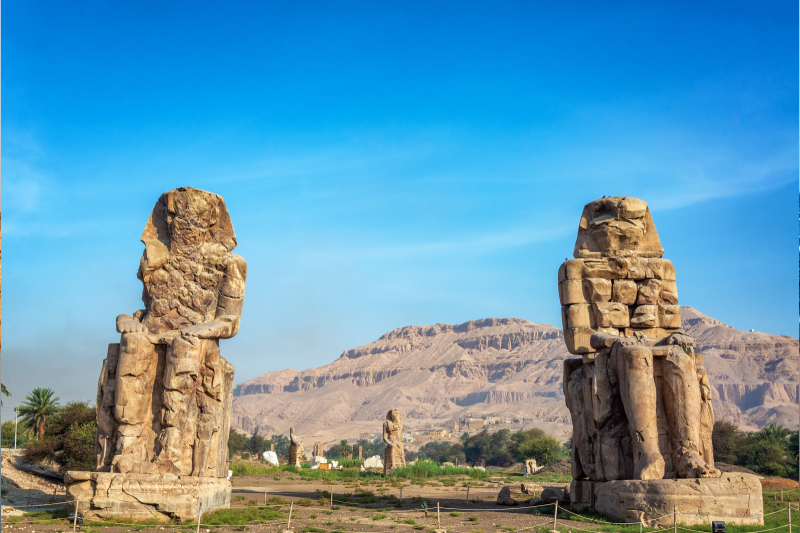
The Colossi of Memnon Tour from Hurghada is a magical tour that will amaze you with the great height of the Colossi of Memnon (Kom el-Hattan), 18 meters (60 feet) above the fertile agricultural floodplains of the west bank of Thebes. They are among the most magnificent and architecturally magnificent compact stone monuments in the ancient world.
Carved from solid blocks of golden quartzite quarried near modern Cairo and transported over 600 kilometers south to Luxor, these twin 720-ton statues have guarded the entrance to the vast mortuary complex of Pharaoh Amenhotep III (18th Dynasty) for more than 3,400 years.
Booking a specialized Colossi of Memnon tour from Hurghada provides an extraordinary bridge between the coastal resort relaxation of the Red Sea and the monumental scale of pharaonic engineering. Long before modern tourism, these statues were celebrated throughout the Greek and Roman empires due to the famous “Singing Colossus” phenomenon—a natural acoustic wonder triggered by a massive earthquake in 27 BCE that caused the northern statue to emit a resonant musical sound at sunrise.
While many standard commercial tour buses stop at the site for merely five minutes to take a quick photograph, a private guided experience with Manolo Tours Egypt unlocks the rich geological, mythological, and archaeological reality of the entire site. Behind the twin guardians lies the ongoing excavation of the largest mortuary temple ever constructed in ancient Egypt—a sacred sanctuary larger even than Karnak.
Why Book a Colossi of Memnon Tour from Hurghada?
A dedicated Colossi of Memnon tour from Hurghada delivers a direct, comfortable journey across the desert in a private climate-controlled vehicle directly to the West Bank of Luxor. Operating with a dedicated Egyptologist guide, your visit covers the engineering geometry of the twin 720-ton quartzite statues, the relief wall art of the side thrones (Sema-Tawy), the myth of the Singing Colossus, and the ongoing excavations of Amenhotep III’s vast mortuary complex.
Pharaoh Amenhotep III
To appreciate why these giant guardians exist during your Colossi of Memnon tour from Hurghada, we must step back into the Golden Age of the 18th Dynasty (c. 1386–1349 BCE). Pharaoh Amenhotep III ruled over an empire at the absolute peak of its international power, military dominance, and material wealth.
Known to history as “Amenhotep the Magnificent,” the king channeled vast imperial tribute from Nubia, Syria, and Babylon into monumental building projects across Thebes.
The Divine Role of the Twin Monoliths:
The statues do not merely depict the king as a mortal monarch; they portray him in a state of apotheosis—deified as a living manifestation of the sun god on earth. Positioned at the boundary where the fertile Nile agricultural plain met the dry desert burial ground, the statues were designed to be flooded at their bases every summer during the annual Nile inundation (Hapi), symbolizing the king rising eternally from the primeval waters of creation (Nun).
Geological Engineering: Transporting 720 Tons of Quartzite
The sheer physical scale of the Colossi of Memnon represents one of the most astonishing engineering achievements of antiquity. While most pharaonic monuments in Thebes were constructed using local limestone or sandstone quarried directly from nearby Nile cliffs, Amenhotep III’s master architects chose silicified sandstone (red quartzite).
The Transportation Challenge:
Quartzite is an extraordinarily hard stone, composed almost entirely of fused quartz grains, making it far denser and harder to carve than limestone or granite.
Quarrying:
Royal stonemasons used hard dolerite hammerstones and wooden wedges soaked in water to split 720-ton single blocks out of the Gebel el-Ahmar bedrock.
Nile Navigation:
Transporting a single 720-ton stone monolith down the Nile required custom-built wooden super-barges pulled by fleets of rowboats during the peak high-water season.
Offloading & Erection:
Upon reaching the Theban West Bank, workers maneuvered the stones using earthen ramps, wooden rollers, levers, and counterweights to stand them perfectly upright at the entrance of the First Pylon.
Standing directly before these monoliths on a private Colossi of Memnon tour from Hurghada allows you to appreciate the physical impossibility of moving such immense weight across 600 kilometers without modern machinery.
The Legend of the Singing Colossus: Science vs. Classical Myth
For centuries during the Greco-Roman period, the northern statue of the Colossi of Memnon achieved global fame throughout the Mediterranean world, attracting emperors, generals, poets, and historians who journeyed to Upper Egypt specifically to witness a miraculous acoustic phenomenon.
1. The Classical Myth:
To travelers of the ancient Greco-Roman world, the musical sound was believed to be the voice of Memnon, the king of Ethiopia and son of Eos (the goddess of dawn). According to Greek mythology, Memnon was killed by Achilles during the Trojan War. Every morning at sunrise, the statue supposedly wept or sang out to mourn its divine mother.
2. The Scientific Reality:
Modern geological and acoustic analysis has solved the mystery behind the “Singing Colossus”:
Thermal Shock:
The massive earthquake of 27 BCE cracked the northern statue, creating a network of deep, porous fissures through the dense quartzite stone.
Morning Dew & Heat:
Overnight desert dew collected inside these micro-fissures. As the intense morning sun struck the cold stone at sunrise, rapid water evaporation caused microscopic thermal expansion inside the cracks.
Acoustic Resonance:
The escaping steam whistled and reverberated through the hollow stone chambers, producing a clear, bell-like musical sound that echoed across the Theban plain.
When Emperor Septimius Severus attempted to “restore” the statue in 199 CE by stacking heavy sandstone blocks over the cracks, he inadvertently altered the stone’s resonance and permanently silenced the legendary voice.
Discovering this fascinating intersection of classical myth and physical science is a key highlight of a private Colossi of Memnon tour from Hurghada.
Anatomy of the Statues: The Sema-Tawy Reliefs & Queen Statues
While the upper torsos of the Colossi have suffered millennia of erosion and earthquake damage, the massive throne bases remain remarkably intact, offering some of the finest 18th Dynasty stone reliefs in Upper Egypt.
The Sema-Tawy Relief Carvings:
On both side panels of each throne base, your private guide will highlight the deeply carved relief of Sema-Tawy (Unification of the Two Lands):
The Figures:
Two depictions of Hapi, the deity of the Nile inundation, hold the heraldic plants of Egypt—the papyrus of Lower Egypt (Delta) and the lotus of Upper Egypt (Valley).
The Cosmic Knot:
The deities tie these two sacred plants around a stylized hieroglyphic symbol representing the human lungs and windpipe (Sema), visually sealing the political unity and stability of the entire kingdom under Amenhotep III’s feet.
The Lost Mortuary Temple of Amenhotep III & Ongoing Excavations
When the Colossi of Memnon were first erected, they did not stand in isolated fields as they appear today. They guarded the entrance pylon of Kom el-Hettān—the largest, most lavishly decorated mortuary temple complex ever constructed in ancient Egypt.
Why Did the Temple Disappear?
Unlike Karnak or Medinet Habu, Amenhotep III’s mortuary temple was constructed directly on the low alluvial floodplain of the Nile:
Destructive Inundations:
Annual Nile floods soaked the unbaked mud-brick enclosure walls and soft foundations for centuries.
Catastrophic Earthquake:
Around 1200 BCE (during the 19th Dynasty), a violent earthquake collapsed the pylons, columns, and roofs.
Royal Quarrying:
Subsequent pharaohs (such as Merenptah) recycled the fallen stone blocks and statues to build their own nearby funerary monuments.
The Modern Memnon Amenhotep III Temple Project:
Today, under the direction of international archaeological teams, the site is undergoing one of the world’s most dynamic excavation and restoration efforts:
Newly Re-erected Colossi:
Visitors can now see additional colossal statues of Amenhotep III standing at the second and third pylon positions behind the original pair.
Statues of Sekhmet & Stelae:
Archaeologists have unearthed hundreds of black granite statues of the lioness goddess Sekhmet, along with giant victory stelae that once lined the hypostyle courts.
Crowd Avoidance & Golden Hour Photography Strategy
Because the Colossi of Memnon stand directly along the main thoroughfare connecting the West Bank Nile ferry to the Valley of the Kings, timing your arrival dictates the quality of your visual experience and photography.
3 Professional Photography Tips for the Colossi:
The Scale Shot:
Position a person near the base pedestal while shooting with a telephoto lens (85mm–135mm) from across the road. This compresses the background and dramatically highlights the massive 18-meter height of the statues.
The Side Relief Framing:
Move to the northern side of the southern statue during early morning hours to capture the crisp Sema-Tawy relief detail bathed in soft side-lighting.
The Panoramic Sunset Frame:
Capture the twin colossi against the glowing orange backdrop of Mount Qurn (Al-Qurn) as the sun dips behind the royal tombs of the West Bank.
Combining Memnon with Surrounding West Bank Treasures
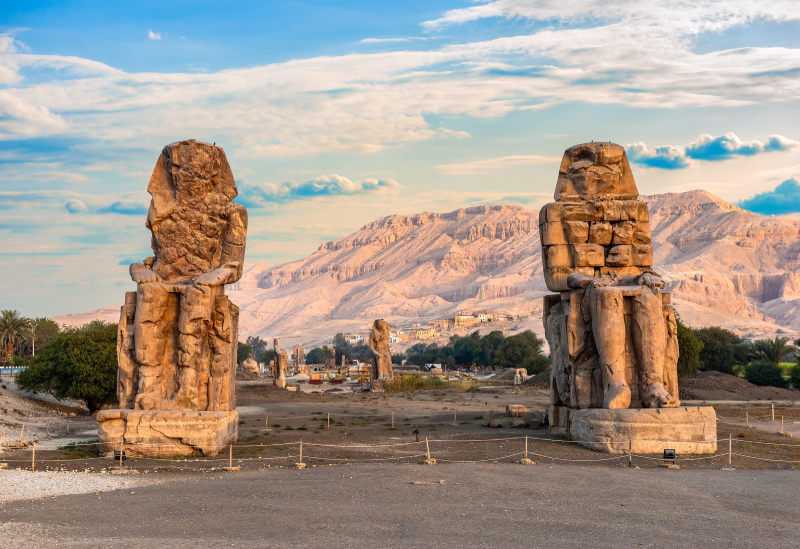
Colossi of Memnon Tour from Hurghada_The Colossi of Memnon
Because a visit to the Colossi of Memnon takes approximately 30 to 45 minutes of detailed exploration, it serves as the ultimate gateway stop for a comprehensive West Bank itinerary.
The Manolo Tours Advantage:
When you book a private Colossi of Memnon tour from Hurghada, your driver and guide coordinate all stops according to your personal pace. Bypassing rigid group schedules ensures you spend quality time at the ongoing Kom el-Hettān excavations before exploring the royal tombs deeper in the valley.
Driving from Hurghada to the West Bank
Executing a smooth, comfortable Colossi of Memnon tour from Hurghada relies on expert road transit across the Eastern Desert divide, followed by crossing the Nile River directly to the monuments of the Theban West Bank.
Strategic West Bank Positioning:
Unlike tours that enter central East Bank traffic first, a dedicated private Colossi of Memnon tour from Hurghada bypasses downtown congestion via the Qena-Luxor bridge route. Your vehicle drives directly onto the West Bank agricultural road, arriving at just as morning light illuminates the quartzite stone faces.
Financial & Entry Ticket Guidance
- Open Plaza Access to the Colossi of Memnon
Viewing the towering Colossi of Memnon is completely free of charge. Positioned along the primary highway leading into Luxor’s West Bank, the open plaza allows visitors to walk right up to the perimeter to admire the 18-meter stone monoliths, inspect the detailed side reliefs depicting Sema-Tawy (the symbolic unifying of Upper and Lower Egypt), and view the outer grounds of Amenhotep III’s mortuary temple. No general entry ticket or admission pass is required.
- Kom el-Hettān Inner Archaeological Excavations
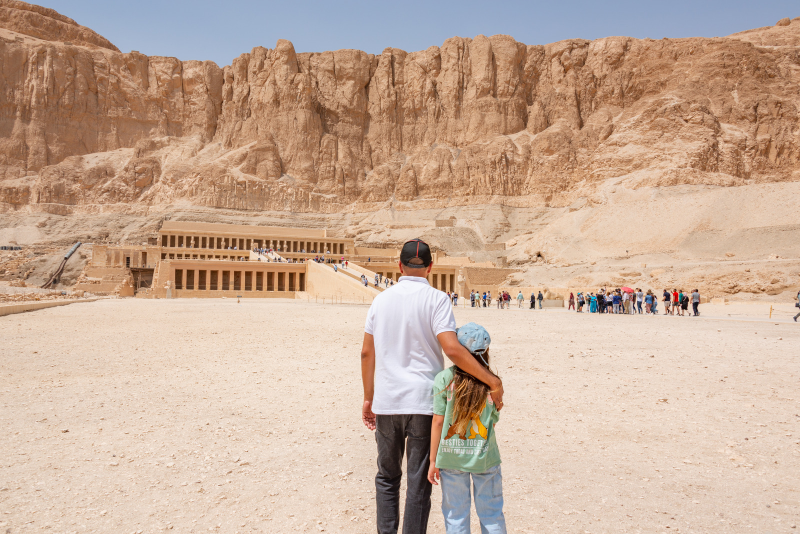
Colossi of Memnon Tour from Hurghada_Kom el-Hettān
While the front plaza remains open to the public daily, the active excavation zones of the broader Kom el-Hettān temple precinct located behind the statues are restricted. Access to inner archaeological trenches, newly re-erected statues, and ongoing restoration areas requires special clearance permits issued directly by the Supreme Council of Antiquities for academic research or specialized site inspections.
- Photography Guidelines at the Site
Visitors are free to take unlimited handheld photographs throughout the entire open plaza area without purchasing a photography ticket. Smartphone cameras, standard digital cameras, and personal photography setups can be used at no cost, making the site an ideal, hassle-free photo stop during transfers across the West Bank.
FAQs About Colossi of Memnon Tour from Hurghada:
Who do the Colossi of Memnon actually represent?
The twin statues represent Pharaoh Amenhotep III (18th Dynasty) seated on his royal throne, depicted in a state of apotheosis as a living manifestation of the sun god.
Why were the statues called “Memnon” by the Greeks and Romans?
Classical Greek and Roman travelers named the northern statue after Memnon, a legendary hero of the Trojan War and son of Eos (goddess of dawn), believing his divine voice called out to his mother at sunrise.
Do the Colossi of Memnon still “sing” today?
No. The acoustic singing phenomenon ended in 199 CE when Roman Emperor Septimius Severus attempted to repair the cracked upper quartzite blocks, accidentally sealing the fissures that created the thermal sound resonance.
How heavy are the Colossi of Memnon statues?
Each statue weighs approximately 720 metric tons and was carved from a single solid block of red quartzite stone.
Where was the quartzite stone for the statues quarried?
The quartzite was quarried at Gebel el-Ahmar near modern-day Cairo and transported over 600 kilometers south up the Nile River on massive wooden barges.
Is there an entrance fee to visit the Colossi of Memnon?
No. Open-air viewing of Colossi of Memnon from the visitor plaza is 100% free of charge. Entrance fees apply only to surrounding enclosed West Bank monuments like the Valley of the Kings.
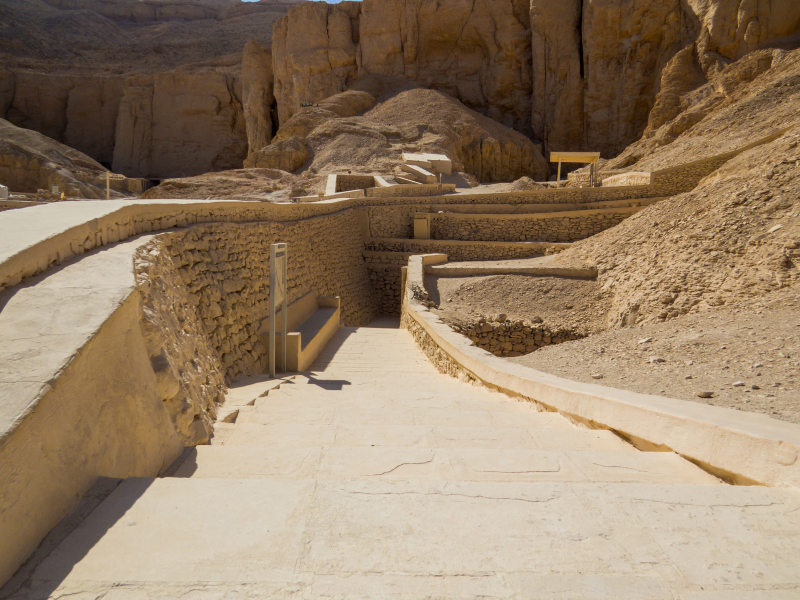
Colossi of Memnon Tour from Hurghada_Valley of the Kings
What temple originally stood behind the Colossi of Memnon?
The statues guarded the First Pylon of Kom el-Hettān—the mortuary temple complex of Amenhotep III, which was the largest funerary temple ever built in ancient Egypt.
How far are the Colossi of Memnon from Hurghada?
The driving distance from Hurghada to the West Bank of Luxor is approximately 3.5 to 4 hours each way via a private climate-controlled vehicle.
What are the small figures carved alongside the main statues’ legs?
The smaller standing figures carved beside the king’s legs depict his Great Royal Wife, Queen Tiye, and his mother, Queen Mutemwiya.
Can a Colossi of Memnon tour from Hurghada be combined with other West Bank sites?
Yes! Because the statues sit at the entrance to the West Bank, a private tour seamlessly combines Colossi of Memnon with the Valley of the Kings and Hatshepsut Temple on the same day.
Key Takeaways
A private Colossi of Memnon tour from Hurghada brings you face-to-face with two 720-ton quartzite monoliths that have stood guard over the Theban West Bank for 3,400 years.
Discover the true geological and acoustic reality behind the ancient legend of the “Singing Colossus” that captivated emperors throughout the classical Roman Empire.
Examine the intricate side-throne reliefs depicting Sema-Tawy—the eternal unification of Upper and Lower Egypt.
Gain expert insight into the active archaeological excavations uncovering the vast lost mortuary complex of Pharaoh Amenhotep III at Kom el-Hettān.
Book Your Private Colossi of Memnon Tour Today
Ready to stand before the colossal 720-ton stone sentinels of Amenhotep III with complete VIP travel comfort, deep Egyptological guidance, and zero crowd stress? Reserve your private tour with Manolo Tours Egypt today.
Book Your Colossi of Memnon Tour via WhatsApp (Instant Direct Confirmation)